
Restricted Agricultural Remedies
Highly Hazardous Pesticides (HHPs)
Important update
Due to ambiguity between the different pieces of legislation, CropLife SA approached the High Court in December 2025 to ask for clarity on whether the term 'restricted agricultural remedy' used in the 'regulations relating to agricultural remedies' are the same as 'restricted-use agricultural remedy' used in the 'PCO regulations'.
The Court ordered that:
- The class of 'restricted agricultural remedy' in Annexure A of the regulations relating to agricultural remedies is not included in the class of 'restricted-use agricultural remedies' in the PCO regulations.
- The class of 'restricted agricultural remedy' in Annexure A of the regulations relating to agricultural remedies is not subject to the regulatory control of the PCO regulations.
This means that the information below is currently being reviewed and will be updated as soon as there is more clarity about the way forward regarding Restricted Use Remedies. Please read this important information that was shared with CropLife SA members in January 2026 about the court ruling.
Background
A New Class of Chemicals
On 25 August 2023, new regulations were published under the Fertilizer, Farm Feeds, Agricultural Remedies and Stock Remedies Act (Act No. 36 of 1947). Although this Act regulates various products and processes, these new regulations are specific to the products referred to as "agricultural remedies" and is known as the "Regulations relating to agricultural remedies".
These regulations define a new class of chemicals referred to as "restricted agricultural remedies".
The definition
A "restricted agricultural remedy" is defined as an agricultural remedy for which the Registrar, out of concern for its human health or environmental risks, has set out additional information to be shown on the label concerning essential conditions in respect of the display, distribution or limitations on use of, or qualifications of persons who may use the agricultural remedy, and such remedy shall comply with the criteria as set out in Annexure A.
For any assistance, please contact admin@agri-intel.co.za
Annexure A (3)
The Four Criteria
Agricultural remedy formulations fulfil the restricted agricultural remedy criteria when such agricultural remedy has one or more of the following characteristics. Each comes with what it means in layman's terms.
Agricultural remedy formulations that meet the criteria of classes Ia or Ib of the WHO Recommended Classification of Pesticides by Hazard.
In layman's terms
Restricted due to acute toxicity; these were previously red band products (before the recent implementation of GHS). For more information on the WHO classification scheme and active ingredients affected, see the WHO classification.
Agricultural remedy formulations that meet the criteria of acute toxicity categories 1 or 2 of the GHS.
In layman's terms
Also restricted due to acute toxicity, but may include additional remedies in comparison to criterion 1, as the GHS considers additional routes of exposure (inhalation), as well as the toxicity of co-formulants, which is not considered by the WHO classification scheme in all cases. For more information, see GHS.
Agricultural remedy active ingredients and formulations listed by the Rotterdam Convention in its Annex III.
In layman's terms
Chemicals that have been banned or severely restricted due to health or environmental concerns. They are subject to the Prior Informed Consent (PIC) procedure: a country exporting a chemical listed on the Annex must inform and get approval from the importing country, encouraging shared responsibility and international cooperation in the management and trade of hazardous chemicals. South Africa is a signatory, and its execution falls within the mandate of the Department of Forestry, Fisheries and the Environment. See the Annex III chemicals.
Agricultural remedy active ingredients and formulations that have shown a high incidence of severe or irreversible adverse effects on human health or the environment.
In layman's terms
Allows the Registrar to include any additional remedies not falling within criteria 1 to 3 that pose unmanageable risks to human health or the environment. For example, methomyl is included due to frequent wildlife poisonings, paraquat due to its use in suicides and dichlorvos due to illegal sales resulting in accidental poisonings and death. Formulations of terbufos and methamidophos are also included.
Acute Toxicity
What Is Acute Toxicity?
Most of these criteria, especially criteria 1 and 2, relate to products that are (predominantly) acutely toxic.
Acute toxicity refers to serious adverse health effects (i.e. lethal) occurring after a single or short-term oral, dermal or inhalation exposure to a substance or mixture.
The data on acute toxicity for an agricultural remedy may be based on experimental data or may be calculated according to standardised methods based on the acute toxicity potential of the ingredients in the formulation.
The test animals used in acute toxicity experiments are mammals (rats and rabbits), used to infer the acute toxicity potential of the chemical on humans.
Acute toxicity values are expressed as (approximate) LD50 (oral or dermal exposure) or LC50 (inhalation exposure) values, or as acute toxicity estimates (ATE; used when the value is calculated). LD = lethal dose; LC = lethal concentration.
LD50 means the amount of a chemical, given all at once, which causes the death of 50% (one half) of a group of test animals.
LC50 means the concentration of a chemical in air or in water which causes the death of 50% (one half) of a group of test animals.
LD50 values are expressed as mg/kg body weight and LC50 values as mg/L or ppmV.
The lower the LD50 or LC50 value, the higher the toxicity of the chemical: a lower dose or concentration is necessary to cause mortality of one half of the test animals.
Use and Labelling
Who May Use Them, and How to Spot Them
Although "restricted agricultural remedies" was only defined in the "regulations relating to agricultural remedies" in 2023, the requirement for these remedies to be restricted to pest control operators (PCOs) has been included in the "Pest Control Operator regulations" since 2011.
According to the "Pest Control Operator Regulations" of 18 February 2011, although employees who perform pest control for their employer on the employer's property generally do not need to be registered as pest control operators (PCOs), employees who handle restricted agricultural remedies must be registered as PCOs, or perform such duties under the direct supervision of a registered PCO. This means that a registered PCO must be physically present at the time and place where restricted agricultural remedies are applied. Consequently, in future, farmers that use these remedies will have to ensure that a person working on the farm has the necessary qualifications to oversee the use of these remedies.
The "regulations relating to agricultural remedies" requires that a restriction notice be included on the label of the agricultural remedy to indicate the limitations on use. Although the current regulations state that this notice should be included at the top of the secondary display panel of the label, this has been amended to the top of the main display panel in the revised regulations submitted to the Minister for approval. Thus, a restricted agricultural remedy should be easily identifiable by means of the restriction notice on the front panel of the label. The restrictions will also be communicated under Section 1 of the Safety Data Sheet.
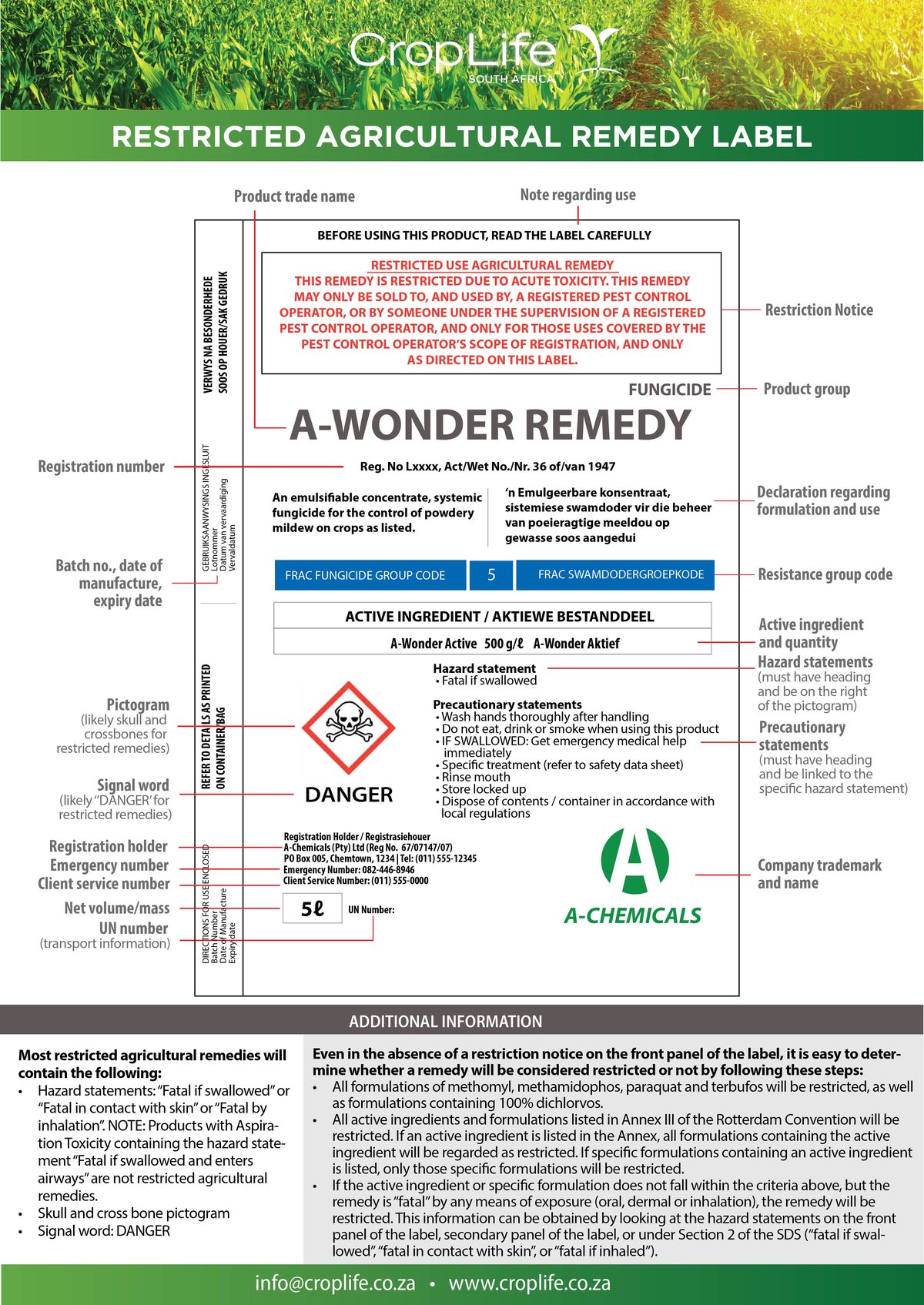
An example of a restriction notice on a restricted agricultural remedy label:
Restricted use agricultural remedy
This remedy is restricted due to acute toxicity. This remedy may only be sold to, and used by, a registered pest control operator, or by someone under the supervision of a registered pest control operator, and only for those uses covered by the pest control operator's scope of registration, and only as directed on this label.
All restricted agricultural remedy labels must contain a similar restriction notice (with some minor variations depending on the reasoning for the restriction) at the top of the main panel of the label.
Sales
Sales of Restricted Agricultural Remedies
In addition to the restriction on use of restricted agricultural remedies, sales of these remedies will also be limited. Distributors/agents must ensure that the person they are selling restricted remedies to is registered as a PCO within the applicable field of certification related to the remedy being sold. Thus, if a remedy is being sold for use in agriculture (excluding aerial application or fumigation which has their own fields of certification), the PCO must be certified in the field of "agriculture and forestry".
In accordance with the "Regulations under the hazardous substances Act 15 of 1973", various measures are already in place for the handling and trading of Group I hazardous substances. "Restricted agricultural remedies" are predominantly acutely toxic and will thus also be regulated under the "Hazardous Substances Act 15 of 1973". Therefore, in addition to the requirements already stipulated for Group I hazardous substances, the following will be applicable:
Who must be registered as a PCO?
Only the end-user of the product (farmer/farmworker). If a supplier sells a remedy to a distributor/agent who sells the remedy to the end-user, the distributor/agent does not need to be registered as a PCO, only the end-user.
Group IA — Group I hazardous substances
Includes aluminium and zinc phosphide.
Group IB — Group I hazardous substances
All chemicals falling within Class 6.1 (toxic substances) according to the UN Recommendation on the Transport of Dangerous Goods Model Regulations, specified in Appendix E and F of the South African Bureau of Standards Code of Practice 10228.
-
A "restricted agricultural remedy" may only be sold to a registered PCO qualified in the specific field of application. Thus, a sale of a restricted remedy may only be made to a person who, upon purchase, provides proof that they are sufficiently qualified and registered to administer the remedy.
Explore more -
On initial purchase, the registered PCO must provide to the supplier/distributor of the remedy a certified copy of their PCO registration certificate, which will be kept on file by the supplier/distributor.
Explore more -
If the person responsible for sales on a farm is not the person who is registered as a PCO, a designated person may purchase a restricted agricultural remedy on behalf of a registered PCO. Upon first purchase, the registered PCO will accompany the sales representative to the supplier/distributor, and will provide a certified copy of the PCO registration certificate along with a signed letter giving consent to the representative to purchase on their behalf. These documents will be kept on file by the supplier/distributor.
Explore more
Pest Control Operators
Becoming a Registered PCO
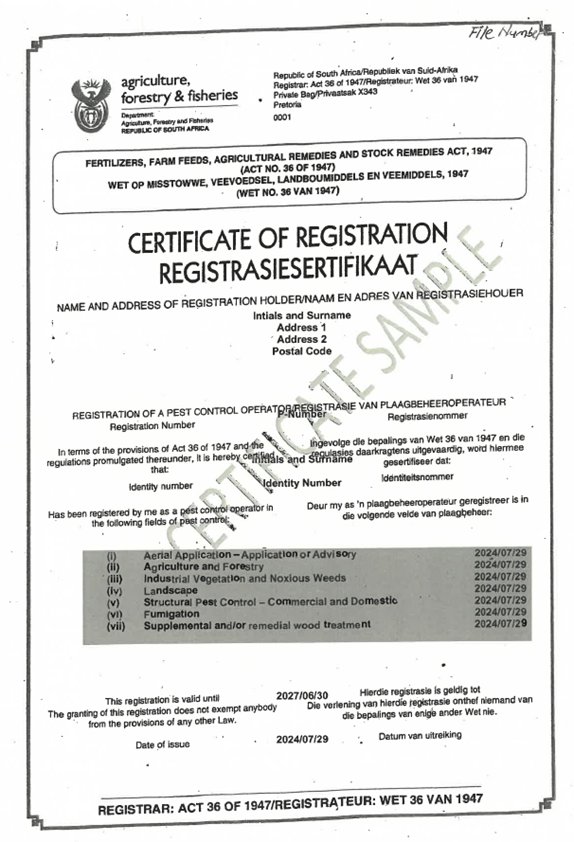
Pest control operators are also regulated under Act No. 36 of 1947, and a person must apply to the Department of Agriculture, Land Reform and Rural Development (DALRRD) to become registered. Pest control operators are certified in specialised areas of pest control, and the following fields of registration are available:
Fields of registration
Fumigation
Aerial application
Agriculture and forestry
Industrial vegetation and noxious weeds
Landscape
Supplemental and/or remedial wood treatment
Structural
Any other relevant specialisation
Each field necessitates specialised training and certification to ensure that the PCO has the appropriate knowledge and skills to safely and successfully apply the restricted remedy. As a result, a PCO certified to conduct fumigation may not administer structural pest control remedies unless obtaining additional structural pest control certification. Remedies that are registered for use in agriculture (with the exception of aerial application and fumigation) will require a PCO to be certified in the field of "agriculture and forestry".
Key requirements for registration
The process for registration as a PCO is circulated annually by DALRRD.
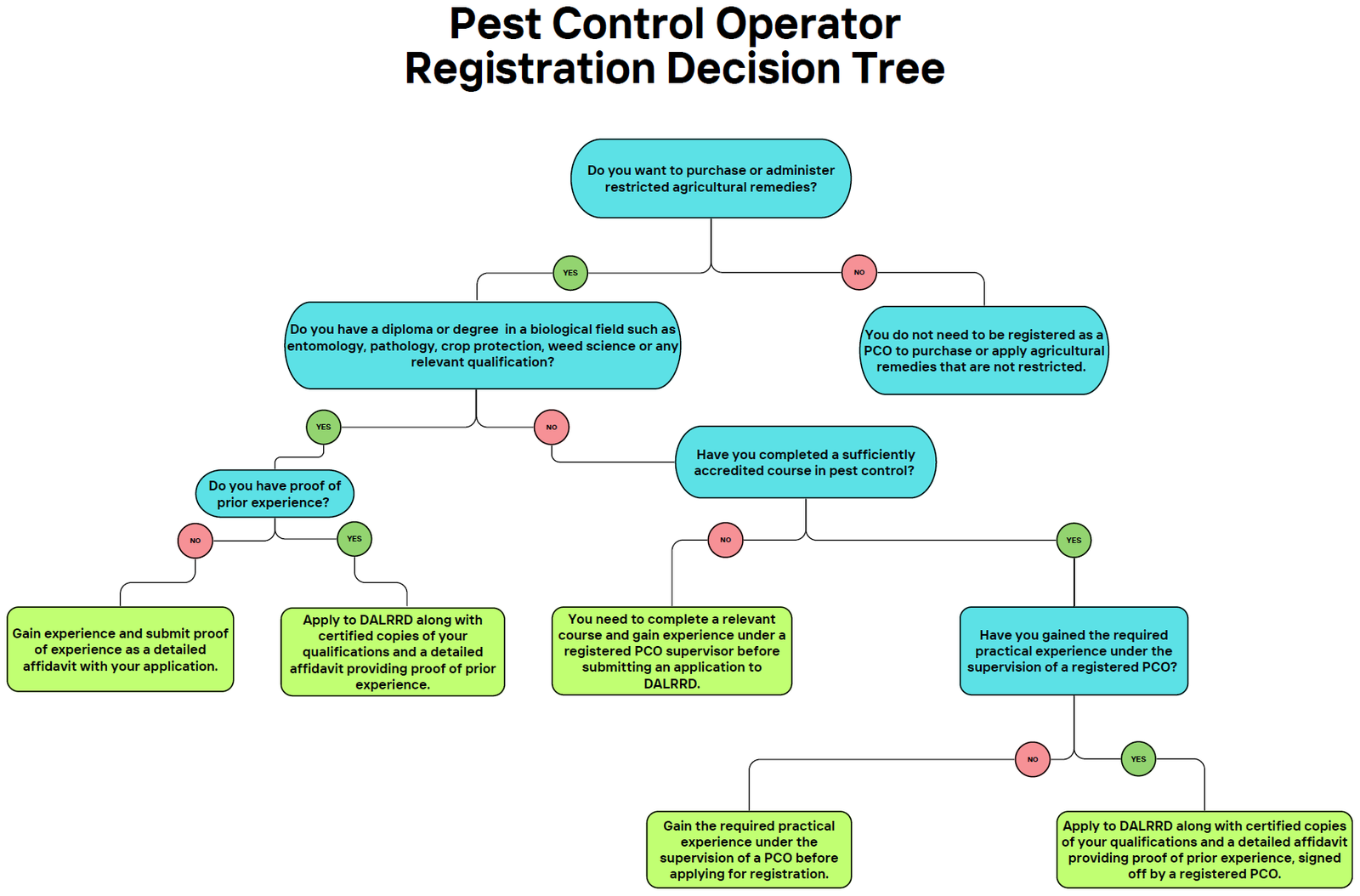
A person must do a course to obtain a national certificate in pest control from a relevant accredited academy.
The person must obtain practical experience under a registered PCO for 6 to 12 months, depending on the relevant field of certification.
A person with a diploma or degree in a biological field such as entomology, pathology, crop protection, weed science, or any relevant qualification may be exempted from the requirement of practical experience, depending on prior experience.
The person should undergo a medical examination and must submit the template report completed by a qualified medical practitioner with their application.
Following the approval of the PCO application, the certificate will be valid for a period of three years. To retain the certificate, the PCO must submit a renewal application before the validity term expires. It is essential that PCOs provide evidence that they are competent and actively working in the field in which they have obtained the certificate.
Affected Remedies
Which Remedies Are Affected?
CropLife SA circulated on 21 August 2024 a list of the agricultural remedy active ingredients likely to be classified as "restricted". Since this list was circulated, a few additional active ingredients have been included — see the table below. It contains 50 active ingredients currently registered in agricultural remedies in South Africa. Some active ingredients are listed twice due to minor variations in the way the compounds were listed in the reference material (for example, paraquat vs paraquat dichloride).
Keep in mind
Only the classification of the active ingredient was taken into consideration, however the classification as a restricted remedy would (in most cases) depend on the classification of the formulation and not just the active ingredient. Consequently, an agricultural remedy containing an active ingredient on the list in low concentrations might not be classified as a restricted agricultural remedy. Similarly, a remedy might be classified due to the presence of a toxic co-formulant and not the active ingredient, in which case the active ingredient will not be included on the list. This list is merely an indication of the remedies that will likely be restricted; it should not be regarded as an exhaustive list.
Even in the absence of a restriction notice on the front panel of the label, it is easy to determine whether a remedy will be considered "restricted":
All formulations of methomyl, methamidophos, paraquat and terbufos will be restricted, as well as formulations containing 100% dichlorvos.
All active ingredients and formulations listed in Annex III of the Rotterdam Convention will be "restricted". If an active ingredient is listed in the Annex, all formulations containing it will be regarded as "restricted". If specific formulations containing an active ingredient are listed, only those specific formulations will be restricted.
If the active ingredient or specific formulation is not listed above, but the remedy is "fatal" by any means of exposure (oral, dermal or inhalation), the remedy will be restricted. Look at the hazard statements on the front panel of the label, or under Section 2 of the SDS ("fatal if swallowed", "fatal in contact with skin" or "fatal if inhaled").
Restricted vs Substance of Concern
Not the Same Thing
The "regulations relating to agricultural remedies" also defines a class of remedies referred to as "substances of concern". Most of these remedies are currently being phased out and the Registrar (Act No. 36 of 1947) no longer has the mandate to approve registrations or renew registrations of remedies complying with these criteria, unless the registration holder conducts a risk assessment and applies for a derogation to keep such a remedy on the market for restricted uses. However, this is only possible if the intended use fulfils the derogation criteria provided in the regulations. Although uses of "substances of concern" will be restricted, these remedies are not the same as "restricted agricultural remedies".
Restricted agricultural remedies — acute
Mostly dependent on the remedy being regarded as acutely toxic.
Substances of concern — chronic
Mostly regarded as toxic by chronic exposure, such as the potential of the chemical to cause cancer, induce genetic mutations or interfere with reproduction or the unborn child over long-term exposure.
The two sets of criteria are not mutually exclusive, and some remedies may fulfil the criteria for both.
Table 1
Active Ingredients Likely to Be Restricted
Active ingredients likely to be regarded as "restricted agricultural remedies" according to the "Regulations relating to agricultural remedies" of 25 August 2023. The list only contains active ingredients registered in agricultural remedies in South Africa. The classification of a remedy as "restricted" will, in general, depend on the final hazard classification of the formulation, and not just the active ingredient. The list was also cross-checked with the Appendix of SANS 10228 to indicate whether the active ingredient is regulated under the "Hazardous Substances Act" as a Group I hazardous substance.
meets the criterion Yes a Group I hazardous substance Note A see the notes below
50 of 50 active ingredients
| Active ingredient | WHO 1A | WHO 1B | GHS cat. 1 | GHS cat. 2 | Rotterdam Convention | Registrar | Hazardous Substances Act |
|---|---|---|---|---|---|---|---|
| Yes Yes | Yes Yes | Yes Yes | Yes Yes | Yes Yes | Yes Yes | Yes Yes |
No active ingredient matches your search or filter.
Note A: Diquat is regulated as a Group IB hazardous substance, which should encompass diquat dibromide.
Note B: Active ingredient flagged only for acute toxicity by inhalation, which was not previously covered by the WHO classification scheme.
Note C: Paraquat is regulated as a Group IB hazardous substance, which should encompass paraquat dichloride.
Learn More
Restricted Agricultural Remedies Resources
Click on a resource below to download the file.